Tuesday, September 29, 2015

FreePort [No 007]: Céleste Boursier-Mougenot

Published on Feb 7, 2014
In this interview, artist Céleste Boursier-Mougenot talks about "from here to ear," an immersive sonic installation at PEM that pairs 70 live zebra finches with amplified guitars in a gallery-turned-aviary. He also discusses his background and influences.


Want to know more about the influential composition "In C" and Terry Riley? Check out this great RadioLab podcast http://www.radiolab.org/story/91934-i...

FreePort [No. 007] runs through April 13, 2014. For more information about tickets, visit this sitehttp://pem.org/exhibitions/164-freepo...

Video created by Chip Van Dyke, Media Production Manager at the Peabody Essex Museum.
  • Category

  • License

    • Standard YouTube License


Zebra Finches on guitar strings

A Glimpse of FreePort [No. 007]: Céleste Boursier-Mougenot

Published on Jan 15, 2014
What is the sound of 70 zebra finches living in a gallery full of amplified guitars?

Artist Céleste Boursier-Mougenot prepares PEM's Barton Gallery for his transportive sound installation titled "from here to ear." This installation will be at the Peabody Essex Museum from January 18 to April 14, 2014. Don't miss this unique experience!

Generous support provided by FreePort funders Jeffrey P. Beale and Fay Chandler. Presented with the support of the Institut Français and the Cultural Services of the French Embassy in the United States. Additional support provided by the East India Marine Associates of the Peabody Essex Museum.

Media Partner: 92.5 The River

Video created by Chip Van Dyke, Media Production Manager at the Peabody Essex Museum.
  • Category

  • License

    • Standard YouTube License


Sunday, August 16, 2015

Peregrine falcon nest in Chicago


Diary of an urban peregrine falcon nest in Chicago – in pictures 
| Environment | The Guardian:


13/05/2015 Chicago is situated on major migrant flyway, so a steady stream of prey is present for the peregrines.

Wild peregrines’ nests are usually inaccessible or the birds not human tolerant. These rare images show the nesting cycle of wild peregrine falcons, with the Chicago skyline as a stunning backdrop
Photograph: Luke Massey/www.lmasseyimages.com


Wild peregrines’ nests are usually inaccessible or the birds not human tolerant. These images are the first of their kind to show the nesting cycle of wild peregrine falcons, with the Chicago skyline as a stunning backdrop


13/05/2015: Peregrines are adapting to breeding in cities around the world. The tall office blocks and apartments are seen by them as pseudo cliffs


20/05/2015: Peregrines are the fastest birds on Earth, and have been recorded diving at speeds of over 200mph. They prey upon birds, from small ducks and pigeons to blackbirds and swifts
Photograph: Luke Massey/www.lmasseyimages.com


11/06/2015 A peregrine falcon nest diary in Chicago: from brooding to hatching and now fledging.


14/06/2015 A peregrine falcon nest diary in Chicago: from brooding to hatching and now fledging.
14/06/2015: This chick has been banded, so that volunteers and scientists can monitor population recovery and location


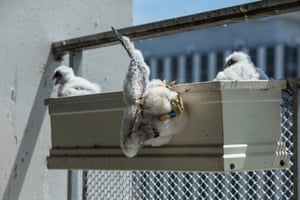
09/06/2015 They hatched in the flower pot but eventually had to jump out on to the balcony as they were too large.
11/06/2015: The Chicago peregrine programme began in 1985 as a cooperative effort to help re-establish peregrines in the Midwest. An estimated 400-500 pairs of peregrines once nested in the Midwest and eastern United States, but by the 1960s, the species had been wiped out regionally
Photograph: Luke Massey/www.lmasseyimages.com


08/06/2015 The Chicago peregrine project monitors the cities 20 breeding pairs of peregrine. They liase with building management and ring the chicks so they can be identified and tracked after leaving the nest.
08/06/2015: The Chicago peregrine programme monitors the city’s 20 breeding pairs of peregrine. They liase with building management and ring the chicks so they can be identified and tracked after leaving the nest
Photograph: Luke Massey/www.lmasseyimages.com


10/06/2015 They hatched in the flower pot but eventually had to jump out on to the balcony as they were too large.

09/06/2015: One chick (from another nest) was once recovered in Ecuador after fledging in Chicago!
Photograph: Luke Massey/www.lmasseyimages.com


See More:
http://www.theguardian.com/environment/gallery/2015/aug/10/diary-of-urban-peregrine-falcon-nest-chicago-in-pictures

Diary of an urban peregrine falcon nest in Chicago – in pictures | Environment | The Guardian:
Source:
http://www.theguardian.com/environment/gallery/2015/aug/10/diary-of-urban-peregrine-falcon-nest-chicago-in-pictures

'via Blog this'


Sparrowhawks


BBC Blogs - Springwatch


Sparrowhawks: Friend or foe?


Sparrowhawks are one of our native species of birds celebrated for their majesty, speed and agility. They’re nature’s Top Gun, with awe-inspiring skills and, maybe, an avian predator that we don’t need to vilify for taking our garden birds.

Sparrowhawks can be identified by their short wings and long, blunt tail.


Sparrowhawks have made a dramatic comeback over the past 30 years.


Studies have shown that sparrowhawk presence has no impact on blue tit populations


This research is from the UK but we have a version of this bird in B.C. A woman described to me how she has one that takes a single sparrow daily from her bird feeder.  She uses it to teach her grandchildren about wildlife survival.  She feels guilty about putting out food for the birds because it sets the ambush BUT that's life...

Denial of Death by Ernst Becker says, 


The American kestrel (Falco sparverius), sometimes colloquially known as the sparrow hawk, is a small falcon, and the only kestrelfound in the Americas. It is the most common falcon in North America, and is found in a wide variety of habitats. At 19–21 cm (7–8 in) long, it is also the smallest falcon in North America. It exhibits sexual dimorphism in size and plumage, although both sexes have a rufous back with noticeable barring. Juveniles are similar in plumage to adults.
The American kestrel hunts by hovering in the air with rapid wing beats or perching and scanning the ground for prey. Its diet typically consists of grasshopperslizards, mice, and small birds (e.g. sparrows). It nests in cavities in trees, cliffs, buildings, and other structures. The female lays three to seven eggs, which both sexes help to incubate. It is a common bird to be used in falconry, especially by beginners. Though not as aggressive a hunter as many other larger falcons, proper training and weight control by the falconer allows many kestrels to become effective hunters of birds in the size range of sparrows and starlings, with occasional success against birds up to approximately twice their own weight.[2]
Its breeding range extends from central and western Alaska across northern Canada to Nova Scotia, and south throughout North America, into central Mexico and the Caribbean. It is a local breeder in Central America and is widely distributed throughout South America. Most birds breeding in Canada and the northern United States migrate south in the winter. It is an occasional vagrant to western Europe.
Source: https://en.wikipedia.org/wiki/American_kestrel


Link: http://www.theguardian.com/environment/gallery/2015/aug/10/diary-of-urban-peregrine-falcon-nest-chicago-in-pictures


BBC Blogs - Springwatch - Sparrowhawks: Friend or foe?:


Source: http://www.bbc.co.uk/blogs/natureuk/entries/43860fa9-d866-4e51-9795-74370a03e169?utm_content=buffer1e633&utm_medium=social&utm_source=twitter.com&utm_campaign=buffer


'via Blog this'


Saturday, July 11, 2015

A Bird Sanctuary Called Pandemonium


Lady Gouldian finches, like these at the Pandemonium Aviaries in California, can show a great deal of intelligence and desire to communicate.
PHOTOGRAPH BY MICHAEL D. KERN


A Bird Sanctuary Called Pandemonium

Life Among the Exotic and the Endangered

Raffin, Michele Book - 2014


In 1996, Michele Raffin, author of The Birds of Pandemonium: Life Among the Exotic and the Endangered, opened a bird rescue center. Today, Pandemonium is one of the largest non-companion bird sanctuaries in the United States, providing lifelong care for more than 350 birds, representing 34 species, some of them critically endangered.

PHOTOGRAPH COURTESY OF ALGONQUIN BOOKS 

Talking from her bird-filled office in Los Altos, California, she introduces us to a two-inch-tall avian architect named Oscar and explains why birds prefer listening to Jingle Bellsover Leonard Cohen, how you can break a parrot's heart, and why birds have made her a better person.

Why the name, Pandemonium?

There's the real reason, and then there's the official reason. The official reason is that pandemonium is the flock name for parrots: a pandemonium of parrots.

But the real reason is that it's really reflective of what life is like here. When you run an organization that has hundreds of birds in a suburban neighborhood, there's always a lot going on. It's raucous, and it's a lot of life. So any of the more idyllic, sweet-sounding names that we considered, and that I'd have preferred, didn't fit who we are.

So many of the birds you write about touch our hearts. I'm torn to have to ask you to tell us just one or two stories—but you must start off with Oscar.

Absolutely. Oscar was a gorgeous Lady Gouldian Finch, but he couldn't fly. He could get off the ground for about an inch or two, but no matter how hard he tried, he really wasn't able to fly like the other finches in his aviary.

I wasn't really aware of what a problem that was for him until nighttime. He wanted to fly up to the roost with the other birds but wasn't able to. So I decided I'd improvise a small perch for him, so he wouldn't be on the ground at night.

Birds are very observant. In fact I think there are more birds watching people than there are people watching birds. So Oscar watched what I was doing—and then he had a better idea. I was using bamboo stakes, and he would hop up on the stake and then focus his eyes to where he wanted the next stake. He actually showed me how to build him a ladder up to the other finches. I was the carpenter, and he was the architect.

It was a very powerful lesson from a very small creature who seemed to have a great deal of intelligence and desire to communicate. That was my first really powerful experience of having a relationship with a bird that was based on a two-way communication. And if there's one thing I would want to communicate to everyone, Simon, it's that cross-species communication is not only possible but desirable from the birds' point of view. I don't think a world in which species are separate is really the natural order.


Pandemonium Aviaries (one of its birdhouses, above) is a bird-centric environment for abandoned and unadoptable birds.
PHOTOGRAPH BY MICHAEL D. KERN

Explain to us why every day is Christmas at Pandemonium. Have you tried playing the birds Leonard Cohen songs?

Leonard Cohen just wouldn't cut it. The parrots are really into beat, and they communicate their preferences very loudly. If they don't like music, they'll just sit there and look at you without moving. And as soon as you put something on that has a good beat, they start dancing or singing. I mean, theyreally dance with the rhythm. Some species seem to have more rhythm than others. Cockatoos are amazing. My African greys are hysterical. They bop around. But it's not species-dependent. Shana, a yellow-headed Amazon parrot, can't keep a beat. She can sing, but she can't dance.

The other day, Tico, a blue-and-gold macaw, was in my office, and we were listening to music. He really likes Disney songs. The Princess collection is his favorite. I've tried to expand his repertoire of show tunes, but Christmas music for some reason is something they all respond to.

Tape loops of Jingle Bells?

It seems like it's endless. The good news is I've learned how to use my iPhone so we have portable music when they're outside in the aviary. It's a common denominator for birds. When I first started in rescue, I'd pick up a very frightened bird and sing to it. I have a terrible voice. I really do! So I don't know if they figured anybody who sang as poorly as I did was no threat—or whether there's something universal about music among creatures that make their own music. Music forms a bridge.

What's a typical day in your life at Pandemonium, if there is such a thing as a typical day?

A typical day is controlled chaos. In this line of work you have to be prepared to do what it takes. We have several guiding principles, and one of them is that we're bird-centric. What the birds need, the birds get. If there's a bird emergency, whatever else is scheduled gets canceled. That's just the way it is. One has to be prepared to be flexible.

There's a lot of coordination. We get a lot of donated food. Our birds get an amazing diet of fresh fruits and vegetables every day. We feed live insects, nectars, pollen, grains, pellets. It's a huge task. When there are babies, we want the parents to raise them. But sometimes the eggs are abandoned, or the babies are abandoned, so we have to raise them by hand. That means feeding every two hours, day and night. It's pretty grueling, but we have to pretend to be bird parents. We go "peep peep peep" with some of them, and pull their hair like their parents would, or make them eat something they don't want to.

Nobody takes a salary in my office. I don't take a salary. So we constantly have to fund-raise. It's a labor of love. But it's also joyful. It's full of, oh my God, so many just sparkling moments! Yesterday, two blue-combed pigeons were feeding their baby, and I just watched and watched. It was such a joy to see the parents feeding the baby in a way that's natural for both of them. It is so beautiful. We've got lovely gardens, and all kinds of wild birds and butterflies. We're about life. About giving life, protecting life—and ensuring that it goes on.

Author Michele Raffin says her time with birds has been "transformative."
PHOTOGRAPH BY MICHAEL D. KERN

Pandemonium is not just a bird rescue. You're involved in the conservation and the saving of species threatened with extinction, aren't you?

Absolutely. We shut down the rescue element in 2009, because a rescue has animals coming in and going out when they find a home. We were a sanctuary for unadoptable birds that had no other place to go for a variety of reasons: They needed big aviaries, or they were handicapped, or they were no longer wanted. There were a finite number of birds that we could save, though—a few hundred.

As conservation breeders and educators we can save many more birds. We can hopefully even save species. Our focus is on six specific species, such as the crowned pigeons of New Guinea, which are our modern-day dodos—like the dodo they could become extinct if we don't do something to conserve the species. We don't know how many are left in the wild. There have been no surveys recently. But our intention is to one day return this species to their original home, the wilds of New Guinea. It's not going to happen overnight, but that's our goal.


It's not a responsibility to be taken lightly. They're wonderful, amazing birds that make incredibly exotic pets. But it's much more important to protect and honor the wild in them and to one day repopulate forests that also need to be protected from deforestation caused by the palm oil industry.

Tico, a blue-and-gold macaw who lives at the sanctuary, is very emotional and loves Disney tunes.
PHOTOGRAPH BY MICHAEL D. KERN

New research shows that animals and birds are capable of complex emotion previously believed to be the preserve of us bipeds. Has that been your experience?

Absolutely. In so many different ways. I say somewhere in the book that birds mourn, they love, they court, they have emotional memory, they make decisions about who they like and who they don't like. They're complex.

Tico, my macaw, is very emotional. He gets really furious with me at times, and I just sort of act silly and joke with him. Sometimes that works, and he forgets he's angry at me. But other times I just have to say, I'm really sorry, Tico. I fetch treats, I court him.

There's no question in my mind after living with birds for so many years that they do have feelings and that in some cases their feelings are very strong for their mates and their children. And they really suffer when something happens to someone else in their family.

You quote Antoine de Saint-Exupéry, "you remain responsible forever for what you have tamed." Talk about the emotional turmoil rescue animals face after being dumped by their human being.

You have to understand that parrots, in particular, have been tested to have the intelligence of a two- to four-year-old human child. They're very smart and have emotional intelligence. If you were to take a three-year-old human child and suddenly without warning or explanation, put that child in a new family, or environment, with new rules, new food … how would that child react? How would that child feel?

The average number of homes a companion bird has in one lifetime is about seven. That's tough on them. It takes time for them to come to terms with the change and with their new environment. They grieve the loss of their family—their flock.


The strategy I chose when I was doing rescue was to meet the birds on their own terms. I didn't try to rush them. I let them know over and over again that I was going to be kind to them, that I was trustworthy.


Shana, one of our parrots, took a very long time to recover. I almost gave up, but when she came around, she came around big time. She has such gusto and joie de vivre. She just loves life and is this positive diva, the funniest bird in the center. But it took time for her to recover from the rejection of being given up by her original family.

You write that the human understanding of the emotions of birds is inadequate at best and that the term "bird-brained" is a misnomer. Unpack that idea for us.

"Bird brain" is actually quite a compliment, because if you look at the size of their brain in relationship to their body, you see how incredibly intelligent they are. I just read some research on fairy wrens a couple days ago. Did you know that when the babies are still inside the eggs, they learn a password from their parents that's useful when they hatch? This is because there are parasitic birds that lay eggs in fairy wren nests, and those babies tend to hatch earlier and are bigger. So the wrens have a way to distinguish their true offspring before they hatch.

We thought humans were the only ones who knew embryos can hear. But it's probably true of many different species. We understand so little of the world around us.

I think of birds and other creatures as fellow travelers on this Earth, not here to serve us, but … how do I put this? They're fellow nations, to be respected, admired, cared for—and definitely to be preserved.

You're clearly very deeply involved with your birds. How do you combine this with your non-avian relationships?

Birds have taught me to be a better person. They require great authenticity and quiet. Before my relationship with birds I probably talked without thinking more often than not. I was more active than receptive. Now I focus on being the right person.

I don't know how to explain it, Simon, except that you can't be one thing with an animal and then something else with a person. If you have a great relationship with animals, it translates over to your relationship with the human animal. When you're in a relationship where your best qualities are demanded, including the wild in you, it can only have positive ramifications in your relationships across other species, including the human species. My life with birds has been transformative.


Simon Worrall curates Book Talk. Follow him on Twitter or at simonworrallauthor.com.

Source: http://news.nationalgeographic.com/2014/11/141112-california-bird-sanctuary-pandemonium-animals-conservation-ngbooktalk/


Tuesday, April 1, 2014

The Timor Zebra Finch 2


by Roy Beckham
www.efinch.com


There has certainly been a trend in America for larger more robust Zebra finches of many different colors, so it may be surprising to see a small, skinny gray Zebra finch on the show bench.

That has happened recently with the arrival of the Timor Zebra finch.


The Timor is the only subspecies of the Australian Zebra finch that we are all so familiar with, yet for many years has been unavailable to U.S. aviculturists.

Nearly two years ago a small number of Timor Zebra finches were included in a shipment of Timor Sparrows and other birds from the region as "filler" birds.

They are now being established in the U.S. through the efforts of a few dedicated Zebra finch fanciers.

- See more at: http://www.zebrafinch-society.org/article_timor.htm#sthash.FXwLvIB3.dpuf


Read More: http://www.zebrafinch-society.org/article_timor.htm

Thursday, February 6, 2014

Chickweed as a food source for Finches


Star Chickweed in Flower


Herbs for Birds - Chickweed

By Marie Miley-Russell
Published in the DRAGON News March 2008

As its name, “chick weed” implies, this plant has been given to birds for nearly as long as birds have been kept in captivity. In fact, John Gerard wrote of chickweed in his classic 1597 English text on medicinal plants Herbal or General History of Plants that “little birds in cadges (especially Linnets) are refreshed with the lesser Chickweed, and also rabbits; cows and horses will eat it; sheep are indifferent to it, but goats refuse to touch it”. I have been told by experienced breeders that fanciers used to tear up fresh chickweed plants and provide them- dirt, roots, and all- to their birds to condition them for breeding. It is a well known tonic for caged birds and poultry.
Although the name has been applied to a number of different plants, Stelleraria media is the common garden weed with which most are familiar. It can be found nearly everywhere on the planet. Chickweed is a low growing persistent annual plant that forms dense mats and readily self-seeds. It has been called the “most common weed on the planet” so one is almost certain to find it growing somewhere nearby.
The plant’s leaves are excellent sources of vitamins A (in the form of beta carotene), B, C, and D and are also a rich source of minerals such as calcium, potassium, phosphorus, manganese, zinc, magnesium, copper, and iron. It is also very high in alpha linolenic acid, an Omega-3 fatty acid that is important to cardiovascular health. Other plant sources of alpha linolenic acid commonly fed to canaries include flaxseed, rapeseed, soybeans, wheat germ, purslane, and green leafy vegetables such as spinach, kale, and broccoli. Of these, chickweed and flaxseed are the best sources of this vital fatty acid.
Chickweed should be harvested in early spring and late fall. There is an old saying that “chickweed tastes best when the trees have no leaves”. Chickweed can be used before, during and after flowering. Chickweed prefers cooler weather and sunny to partially shady areas. If in doubt when harvesting chickweed, snap a stem to see if it is dry- if milky sap runs out, toss it. Also, as with ALL wild-harvested food, be careful to harvest only in areas that have not been treated with herbicides or pesticides and avoid harvesting plants from roadsides, which may be contaminated by runoff and other pollutants.
Fresh chickweed does not freeze well so it must be used fresh or dried. Good quality dried herbs should retain a deep green color. If the leaves lose their color, the herbs should be discarded. Dried chickweed may be placed in a plastic freezer bag and stored in the freezer for 6 months or so.
Herbalists value chickweed for its ability to cool inflammation. It is reported to stop bleeding in the stomach and bowels, so it could be beneficial for birds with gastrointestinal problems. Chickweed also reportedly has diuretic properties and may help eliminate toxins from the system.
The most practical form of chickweed to use during the winter months when most breeders are beginning to condition birds for breeding is the dried form. This can be purchased at a reasonable cost through bulk herb suppliers. I supply it as a part of the herb mixture provided to my birds year-round. It is relished by the birds and is the one picked out first before the rest are eaten. In the spring, entire fresh plants are provided to the birds in the flight and they disappear in short order.

Disclaimer: This site contains information about a number of nutritional supplements I have found useful in my bird room. I am not a medical professional, a veterinarian, or an herbalist and therefore I am not qualified to diagnose illness or recommend treatment for your pets. The information contained on this website is presented for educational purposes only.

No warranty or guarantee of a cure is expressed or implied with any information on this site, nor do I make any representations regarding the use or the results obtained with the information. In no event shall I be liable for any loss or damage whatsoever which may arise from the use of information on this site. Use this information at your own discretion.

Herbs may be harmful when taken in excessive amounts, in conjunction with other herbs or medications, or when taken for the wrong condition. The fact that herbs are natural does not mean that they are all safe. You are advised to use caution when offering any herbal supplement to your pet. If your bird is ill, an avian veterinarian should be consulted.
 
 
  webmaster@americansingercanary.com.


Source:
Link:  http://americansingercanary.com/chickweed.htm


Food for Humans


Birds, however, are not the only creatures which delight in feasting upon chickweed. With its fresh, mild taste, this leafy plant makes a delightful addition to salads. Gregory L. Tilford gives chickweed rave reviews in his book "Edible and Medicinal Plants of the West," calling it "without doubt one of the most enjoyable wild salad greens in existence."

In addition to being eaten raw, chickweed can be steamed or sauteed in a manner similar to spinach. It can be substituted for lettuce or spinach on sandwiches or as an exotic garnish. Chickweed also makes a singular soup ingredient.

Chickweed is nutritious as well as delicious, containing significant amounts of vitamins A, B, C and D as well as calcium, iron, copper, manganese, potassium, sodium and zinc.

In addition to its abundance of essential vitamins and minerals, chickweed contains resins and glycosides possessing antiseptic qualities. For this reason, it has long been used to make medicinal poultices to be applied to the skin for the treatment of a number of conditions. In the 1860s and 1870s, herbal catalogs published by Shaker communities included chickweed. The Shakers utilized this herb to treat ophthalmia, or inflammation of the eye, as well as erysipelas, an acute bacterial skin infection.

Internal Medicinal Use

In addition to its culinary use as a nutritious green vegetable and its therapeutic use as an external poultice for skin infections, chickweed has also been used to brew a medicinal infusion. In his book "Medicinal Plants in Folk Tradition: an Ethnobotany of Britain & Ireland," David E. Allen reports the use of chickweed tea as a traditional cure for insomnia, as well as for loosing excess weight. Allen also asserts that in Essex, chickweed tea was drunk to cure rheumatism.


Resources


 Link: http://www.ehow.com/info_8038053_uses-chickweed.html